

Top 5 Essential Oils for Radiant Skin: Benefits and Safe Use
Radiant skin is often described as smooth, hydrated, calm, and naturally reflective. It is not simply skin that appears shiny, nor does it require a complicated collection of products. In practice, visible radiance usually depends on a comfortable skin barrier, consistent hydration, appropriate sun protection, and proper management of concerns such as acne, inflammation, dryness, or uneven pigmentation.
Essential oils are frequently promoted as natural shortcuts to this result. Social media posts may claim that one oil can brighten dull skin, erase blemishes, reduce wrinkles, and balance oil production at the same time. Such claims should be approached carefully. Essential oils are concentrated aromatic substances, and “natural” does not automatically mean gentle, non-irritating, or clinically effective. The U.S. Food and Drug Administration notes that plant-derived ingredients can still be toxic, irritating, or likely to cause allergic reactions when placed on the skin.
This does not mean every essential oil must be avoided. A well-formulated product may provide a pleasant sensory experience and complement a simple skincare routine. Certain ingredients, particularly tea tree oil, may also have evidence for specific concerns. The key is to understand what each oil may realistically contribute, how strong the research is, and whether it suits your skin.
In this guide, I examine the Top 5 Essential Oils for Radiant Skin, compare their uses, explain their limitations, and provide practical safety guidance. The goal is not to promote essential oils as miracle treatments. It is to help you make a more informed decision while protecting the health and comfort of your skin.
What Radiant Skin Really Means
Radiant skin is a visual result created by several connected factors rather than a single ingredient. When the surface of the skin is smooth and adequately hydrated, it reflects light more evenly. When the skin barrier is comfortable, the complexion may also appear calmer and less affected by flaking, tightness, irritation, or visible redness. By contrast, dehydrated or inflamed skin may look rough and dull even when it produces excess oil.
This distinction is important because an essential oil cannot solve every cause of dull-looking skin. If the problem is dehydration, a moisturizer containing humectants and emollients is usually more relevant. If the problem is sun-related pigmentation, daily sunscreen and evidence-based treatment matter more. If the skin looks uneven because of active acne, a properly designed acne routine may be needed. Essential oils may play a small supporting role, but they should not become the foundation of treatment.
A professional approach begins by identifying the actual concern. Ask whether your skin feels dry, looks flaky, becomes oily during the day, reacts to fragrance, develops frequent breakouts, or shows persistent discoloration. These details are more useful than choosing an oil based only on a trend.
I also recommend evaluating the products already in your routine. Over-exfoliation, harsh cleansers, frequent product switching, and the use of several fragranced formulas can reduce comfort and visible radiance. Before adding another concentrated ingredient, simplify the routine and make sure the basics are working. Dermatologists consistently emphasize gentle cleansing, suitable moisturization, and sun protection as central parts of healthy-looking skincare.
Healthy Radiance Begins With the Skin Barrier
The skin barrier is the outer protective system that helps retain water and limit the entry of irritants. When this barrier is functioning well, the skin is more likely to feel comfortable and appear smooth. When it is disrupted, common signs include tightness, flaking, burning, rough texture, sensitivity, and increased redness. These changes can make the complexion look dull even when there is no underlying medical condition.
Supporting the barrier does not require an aggressive routine. A mild cleanser, an appropriate moisturizer, and consistent sun protection often provide a better foundation than frequently changing oils or active ingredients. For dry or sensitive skin, dermatologists commonly recommend fragrance-free products because fragrance ingredients can contribute to irritation. It is also useful to apply moisturizer after cleansing, while the skin still contains some surface moisture.
Essential oils should be considered only after this foundation is stable. If an essential-oil product repeatedly causes tingling, burning, itching, or prolonged redness, those reactions should not be interpreted as signs that the product is “working.” They may indicate irritation or sensitivity. Continuing to use an uncomfortable product can undermine the smooth, calm appearance that most people associate with radiant skin.
Essential Oils Are Different From Carrier Oils
Essential oils and carrier oils are often grouped together in online skincare advice, but they are not the same type of ingredient. Essential oils are concentrated, volatile aromatic substances obtained from plant material. Tea tree, lavender, chamomile, geranium, and frankincense oils fall into this category. Their strong aroma comes from compounds that evaporate relatively easily and may affect the skin even in small quantities.
Carrier oils are non-volatile oils used to dilute essential oils and spread them across a larger surface. Jojoba oil, sunflower seed oil, grapeseed oil, and rosehip seed oil are common examples. Squalane is also used as a lightweight emollient in many facial products, although its chemical structure differs from traditional plant oils.
This difference matters because the softness associated with an essential-oil blend may come mainly from its carrier base. The carrier oil reduces friction, helps limit excessive concentration, and may support the skin’s surface by supplying emollient lipids. The essential oil usually contributes fragrance and other plant compounds, but it is not the main moisturizing component.
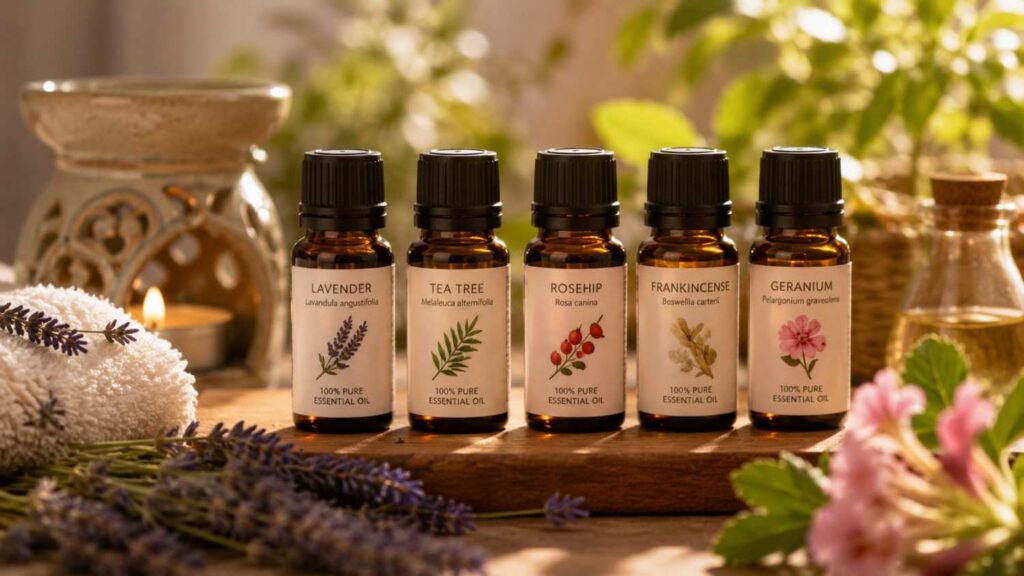
Rosehip seed oil is frequently mislabelled as an essential oil. It is a pressed carrier oil and should be discussed separately when evaluating natural oils for glowing skin.
Top 5 Essential Oils for Radiant Skin
The following five oils are widely used in cosmetic products and frequently appear in searches for the best essential oils for glowing skin. They have not been selected because they can guarantee brightness, wrinkle reduction, or permanent correction of pigmentation. Instead, each one has a recognizable role in skincare discussions, cosmetic formulation, traditional use, or limited clinical research.
Tea tree oil is the most evidence-supported option for a defined facial concern because several studies have examined tea tree formulations for acne. Lavender, chamomile, geranium, and frankincense have weaker evidence for visible skin outcomes, although they remain popular in facial oils, moisturizers, cleansers, masks, and aromatherapy-inspired products.
When comparing them, consider the complete formula rather than focusing only on the highlighted botanical. A frankincense moisturizer may make the skin feel softer because it contains glycerin, squalane, fatty alcohols, or ceramides. A chamomile cleanser may feel comfortable because it uses mild surfactants and has a suitable pH. A tea tree gel may work differently from undiluted tea tree oil because its concentration, base, and application instructions have been controlled.
It is also important to separate cosmetic benefits from medical claims. A product may be marketed to improve the appearance of the skin, but claims to treat acne, eczema, infection, or another condition require a higher level of evidence and regulatory consideration. The FDA distinguishes cosmetic purposes from drug-related treatment claims.
The most appropriate oil is therefore not simply the most popular one. It is the option that matches a clear goal, appears in a suitable formulation, and does not cause irritation.
| Essential Oil | Best For | Main Benefit | Evidence Strength | Suitable For |
|---|---|---|---|---|
| Tea Tree | Blemish-prone skin | Supports mild acne care | Moderate | Oily and acne-prone skin |
| Lavender | Evening skincare routine | Adds a calming aromatic experience | Limited | Normal to combination skin |
| Chamomile | Sensitive-feeling skin | Comfort-focused skincare formulations | Limited | Sensitive skin (with allergy caution) |
| Geranium | Facial oil blends | Cosmetic fragrance and balanced skincare routines | Limited | Normal and combination skin |
| Frankincense | Mature-looking skin | Commonly included in anti-aging formulations | Limited | Dry and mature-looking skin |
1. Tea Tree Essential Oil for Blemish-Prone Skin
Tea tree essential oil is obtained from Melaleuca alternifolia, a plant associated with Australia. Of the five oils in this guide, it has the most relevant clinical evidence for blemish-prone skin. A randomized, double-blind trial involving 60 people with mild-to-moderate acne compared a 5% tea tree oil gel with a placebo over 45 days. Another study of tea tree products used over 12 weeks reported improvement in mild-to-moderate acne.
These findings do not mean pure tea tree oil should be applied directly to every blemish. The research involved formulated products with controlled concentrations, not unrestricted use from a concentrated bottle. Reviews also note that evidence for many promoted tea tree applications remains limited, and stronger or more extensive clinical studies are still needed.
Tea tree oil may cause dryness, redness, irritation, or allergic contact dermatitis. Oxidized oil may be especially problematic, so storage and product age matter. For occasional mild blemishes, choose a clearly labelled facial product and follow its directions. Persistent, painful, widespread, or scarring acne should be assessed by a dermatologist rather than managed only with essential oils.
2. Lavender Essential Oil for a Calming Routine
Lavender essential oil is commonly derived from Lavandula angustifolia and is widely used in aromatherapy, personal care, and fragranced skincare. Its familiar floral scent can make an evening routine feel calming and enjoyable, which may encourage consistent self-care. However, an enjoyable sensory experience should not be confused with proven dermatological treatment.
Lavender is often described online as anti-ageing, soothing, balancing, or healing. High-quality human evidence showing that topical lavender oil directly improves facial radiance, removes wrinkles, or corrects pigmentation remains limited. Its most realistic role in a skincare product is usually fragrance or a supporting botanical component within a broader formula.
Topical lavender products may cause allergic skin reactions in some people. The risk may be more relevant for users with eczema, rosacea, fragrance sensitivity, or an already damaged skin barrier. The National Center for Complementary and Integrative Health specifically notes that skin reactions can occur with topical lavender products.
For facial use, I recommend selecting a professionally formulated product rather than adding undiluted lavender drops to a cream or serum. Stop using the product if it causes persistent itching, burning, swelling, or redness. Fragrance-free skincare may be more suitable when the skin is highly reactive.
3. Chamomile Essential Oil for Comfort-Focused Formulas
Chamomile skincare may contain German chamomile, commonly identified as Matricaria recutita, or Roman chamomile, commonly identified as Chamaemelum nobile. These plants are related but do not have identical chemical profiles. A responsible product should state the botanical name so users can identify which ingredient is actually present.
Chamomile is frequently included in products designed for dry, uncomfortable, or sensitive-looking skin. It is often associated with soothing care, but its reputation should not be treated as proof that every chamomile formula is appropriate for sensitive skin. The NCCIH states that topical chamomile may be safe at certain doses for short-term use, while reliable evidence for many claimed medical benefits remains insufficient.
Allergy history is particularly important. People who react to plants in the daisy family may also be sensitive to chamomile. A product can contain a gentle-sounding botanical and still cause a rash.
When selecting chamomile oil for sensitive skin, examine the complete ingredient list. A rinse-off cleanser or low-fragrance moisturizer may be easier to tolerate than a concentrated facial oil. Patch test the complete formula and introduce it separately from other new products. The realistic goal should be comfort and routine compatibility rather than dramatic brightening.
4. Geranium Essential Oil for Aromatic Facial Blends
Geranium essential oil used in cosmetics usually comes from scented Pelargonium species, often listed as Pelargonium graveolens. It has a floral, green, and slightly herbal aroma that makes it popular in facial oils, body products, perfumes, soaps, and aromatherapy-inspired blends.
Marketing descriptions often claim that geranium oil balances oil production, tightens pores, improves circulation, or works equally well for dry and oily skin. These statements are common, but strong human clinical evidence supporting them is limited. It is more accurate to describe geranium as an aromatic cosmetic ingredient than as a proven treatment for oiliness, enlarged pores, or uneven pigmentation.
A geranium product may still feel pleasant and support a consistent routine. Its overall performance, however, depends on the surrounding ingredients. A facial oil containing squalane, jojoba oil, and a small amount of geranium may soften the skin primarily because of the emollient base.
As with other fragrant botanical oils, geranium can contribute to allergic contact dermatitis in susceptible users. DermNet identifies essential oils as possible causes of contact allergy and notes that repeated exposure may lead to sensitization.
Choose products with clear ingredient information, avoid undiluted use, and discontinue application if redness, itching, or swelling develops.
5. Frankincense Essential Oil for Mature-Skin Formulas
Frankincense is obtained from the resin of trees belonging to the Boswellia genus. It has a warm, resinous aroma and a long history of cultural, ceremonial, and traditional use. In modern skincare, it frequently appears in facial oils, moisturizers, serums, and products marketed toward mature or dry skin.
Promotional claims often state that frankincense tightens the skin, smooths wrinkles, regenerates cells, or removes dark spots. Evidence supporting these specific cosmetic outcomes is limited. Information about Boswellia should also be interpreted carefully because research on oral extracts or different plant preparations cannot automatically be applied to topical frankincense essential oil. The NCCIH notes that topical or aromatherapy use may be safe in certain contexts, but safety information does not prove anti-ageing effectiveness.
Frankincense oil may still serve as a fragrant component in a well-designed mature-skin formula. The visible softness or plumping associated with such a product may come from glycerin, squalane, ceramides, peptides, or other moisturizing ingredients rather than the essential oil itself.
I recommend evaluating the full ingredient list and avoiding products that promise results comparable to medical treatments. Mature skin generally benefits more consistently from moisturization, broad-spectrum sunscreen, and evidence-based active ingredients chosen according to tolerance.
Essential Oil Comparison for Different Skin Concerns
Selecting an essential oil according to skin type can be difficult because popular categories such as “dry,” “oily,” and “sensitive” do not tell the whole story. A person may have oily skin with dehydration, dry skin with acne, or generally resilient skin that reacts specifically to fragrance. The same oil can therefore feel suitable for one person and irritating for another.
The most useful comparison begins with a specific goal. Tea tree oil may be considered when mild blemishes are the main concern. Lavender may appeal to someone who values a relaxing fragrance but does not have scent sensitivity. Chamomile may appear in comfort-focused formulas, although allergy history must be considered. Geranium is primarily relevant to aromatic blends, while frankincense is commonly used in products positioned for mature or dry skin.
Evidence quality should also influence the decision. Tea tree has limited but relevant human acne studies. The evidence for direct brightening, pore tightening, wrinkle reduction, and pigmentation correction with the other oils is much weaker. This does not make those ingredients useless, but it changes the claims that can responsibly be made about them.
The table below offers a practical comparison. “Best-suited goal” refers to the most reasonable cosmetic use, not a guarantee of treatment. Users with a diagnosed skin condition, persistent irritation, severe acne, or unexplained rashes should seek professional care instead of experimenting with several botanical oils.
| Essential Oil | Most Reasonable Goal | Evidence Level | Main Limitation | Important Caution |
|---|---|---|---|---|
| Tea tree | Supporting mild blemish care | Some human acne research | Not a substitute for complete acne treatment | Irritation and contact allergy |
| Lavender | Aromatic evening skincare | Limited evidence for visible radiance | Mainly a sensory ingredient | Fragrance sensitivity |
| Chamomile | Comfort-focused formulations | Limited reliable clinical evidence | Results depend on the complete formula | Daisy-family allergy |
| Geranium | Floral facial or body blends | Mostly cosmetic and traditional use | “Balancing” claims are not well established | Sensitizing fragrance compounds |
| Frankincense | Aromatic mature-skin products | Limited evidence for anti-ageing effects | Not proven to remove wrinkles or spots | Irritation and exaggerated claims |
Best Choice for Blemish-Prone Skin
Tea tree oil is the most reasonable selection when blemishes are the primary concern because it has been examined in controlled acne studies. This is an important advantage over oils that are promoted mainly through traditional use or marketing language. Even so, the available evidence should be described as promising but limited rather than conclusive.
A tea tree product is most appropriate for mild, occasional breakouts when the formula has been designed for facial use. Look for a clearly stated concentration, usage instructions, and packaging that protects the product from excessive heat, air, and light. Avoid applying pure oil repeatedly to inflamed spots, because irritation may make redness and post-blemish marks more noticeable.
It is also important to understand when tea tree is not enough. Painful nodules, widespread inflammation, frequent scarring, or acne that affects confidence may require evidence-based treatment from a dermatologist. Established acne ingredients include benzoyl peroxide, salicylic acid, and topical retinoids, although the correct choice depends on the individual.
Tea tree oil for acne-prone skin should therefore be viewed as one optional component, not a complete routine. Gentle cleansing, a non-comedogenic moisturizer, sunscreen, and consistent treatment remain essential.
Best Choice for Dry or Dull-Looking Skin
For dry or dull-looking skin, the carrier base is usually more important than the essential oil. Essential oils are volatile aromatic extracts and do not function as primary hydration ingredients. Dry skin generally needs products that attract water, reduce water loss, and soften rough areas. Humectants, emollients, occlusives, ceramides, and suitable carrier oils are more directly relevant to those goals.
A frankincense or lavender facial oil may make the skin feel smoother when it is diluted in jojoba, squalane, sunflower, or another emollient base. In that situation, the visible improvement may come mainly from the base rather than the fragrant essential oil. Users should evaluate the entire formula instead of assuming that the highlighted botanical produced every benefit.
Very dry or sensitive skin often responds better to fragrance-free creams or ointments. The American Academy of Dermatology advises people with dry, sensitive skin to choose gentle, fragrance-free products because fragrance may contribute to irritation.
If dullness is accompanied by persistent flaking, itching, cracking, or redness, adding more essential oils may not be appropriate. First restore comfort with a simple moisturizing routine and seek professional advice when symptoms continue.
How to Use Essential Oils Safely on Your Face
Safe facial use begins with understanding that essential oils are concentrated ingredients. A small bottle may look similar to a facial serum, but it is not necessarily designed to be applied directly to the skin. The concentration, age, storage conditions, surrounding ingredients, and frequency of application all affect the risk of irritation.
The simplest option is to select a finished product formulated specifically for facial use. Reputable manufacturers can control concentration, stability, preservation, packaging, and ingredient compatibility more accurately than most homemade recipes. A finished product should provide a complete ingredient list and clear directions, including whether it is intended to remain on the skin or be rinsed away.
Homemade dilution is more complicated than counting drops. Drop sizes vary according to the bottle, oil viscosity, and dispensing angle. Essential oils also differ in their irritation and sensitization potential. A ratio that appears suitable for one oil may not be appropriate for another. For these reasons, beginners should avoid creating strong facial blends based solely on social media instructions.
Sun exposure is another consideration. The FDA warns that certain citrus oils may be harmful in cosmetics when they are applied to skin exposed to sunlight. Citrus oils are not included in this top-five list, but the warning demonstrates why botanical origin should not be treated as proof of safety.
Introduce only one new essential-oil product at a time. This makes it easier to identify the cause if your skin reacts.
| Safety Practice | Why It Matters | Recommended Action |
|---|---|---|
| Choose facial products only | Facial skin is more sensitive than body skin | Use products specifically formulated for facial use |
| Avoid undiluted essential oils | Concentrated oils may cause irritation or allergic reactions | Always use properly diluted or professionally formulated products |
| Perform a patch test | Helps identify potential reactions before full application | Test on a small area for 7–10 days before regular use |
| Introduce one product at a time | Makes it easier to identify irritation | Wait several days before adding another skincare product |
| Store oils correctly | Heat, light, and air can reduce stability | Keep bottles tightly closed in a cool, dark place |
| Continue moisturizer and sunscreen | Essential oils cannot replace proven skincare basics | Use daily moisturizer and broad-spectrum SPF 30+ |
Follow a Simple Step-by-Step Process
Start by defining your goal. Decide whether you are addressing occasional blemishes, dryness, a preference for aromatic skincare, or another specific concern. A clear goal prevents you from adding several unnecessary oils at once.
Next, select a product intended for the face. Review the complete ingredient list, usage directions, storage guidance, and manufacturer information. Avoid vague products that do not identify the essential oil or provide adequate instructions.
Perform a patch test before using the product widely. When the test period is complete and no reaction has appeared, introduce the product slowly. Apply it according to the label rather than increasing the amount in an attempt to achieve faster results.
Keep the surrounding routine simple. Cleanse gently, apply the essential-oil product in the recommended order, and use a suitable moisturizer. During the day, finish with broad-spectrum sunscreen. Do not combine several new exfoliants, retinoids, acids, fragrances, and essential oils during the same week.
Finally, assess comfort rather than relying only on appearance. Burning, itching, tightness, swelling, or persistent redness are reasons to stop. A product that makes the skin uncomfortable is unlikely to support lasting radiance.
Perform a Proper Patch Test
A patch test helps identify whether a new product may cause visible irritation or an allergic-type reaction before it is used across the face. The American Academy of Dermatology recommends applying a skincare product to a small test area twice daily for seven to ten days. The product should be used in the same amount and manner that you plan to use it normally.
Suitable test locations may include the underside of the arm or the bend of the elbow, where the product is less likely to be washed or rubbed away. Testing behind the ear is sometimes suggested, but the chosen location should remain easy to observe.
Do not continue testing if you develop itching, swelling, blistering, a spreading rash, persistent redness, or significant discomfort. Wash the area gently and stop using the product. A severe reaction, facial swelling, breathing difficulty, or a rash that does not settle requires appropriate medical attention.
A home patch test cannot guarantee that a product will never cause a problem. Reactions can develop after repeated exposure. It is nevertheless a practical first step, especially for people trying a fragranced product or an unfamiliar essential oil.
Store Essential Oils Carefully
Essential oils can change when they are exposed to oxygen, heat, light, or prolonged storage. These changes may affect aroma, chemical composition, and skin tolerance. Tea tree oil is a notable example because older or oxidized oil may be more likely to cause sensitivity.
Store essential oils and essential-oil products according to their labels. In general, keep bottles tightly closed and away from direct sunlight, high temperatures, and humid areas. A bathroom shelf near a hot shower may not be the best location for a concentrated oil. Dark or opaque packaging may help reduce light exposure, but it does not replace proper storage.
Write the opening date on the container if the packaging does not include a clear period-after-opening symbol. Do not use a product indefinitely simply because some liquid remains. Discard it when it passes the labelled expiry period, changes colour unexpectedly, develops an unusual smell, or appears contaminated.
Keep essential oils away from children and pets. Do not transfer them into unlabelled containers, because concentrated oils may be mistaken for another product. Safe storage protects both the formula and the people in the household.
Who Should Be Especially Cautious?
Anyone can experience irritation from a cosmetic product, but certain users should approach essential oils with additional care. People with eczema, rosacea, allergic contact dermatitis, fragrance sensitivity, asthma triggered by scents, or a repeatedly damaged skin barrier may react to products that others tolerate without difficulty.
The condition of the skin at the time of application also matters. A product that felt comfortable in the past may sting when applied after over-exfoliation, sunburn, shaving, a professional peel, or another procedure. Broken, inflamed, or recently treated skin is more vulnerable and should not be exposed casually to concentrated aromatic ingredients.
Age and health circumstances may also change the risk assessment. Products intended for healthy adult skin are not automatically suitable for infants, young children, pregnant users, or people managing medical conditions. Concentrated oils should never be swallowed unless a qualified professional has specifically directed the use of an appropriately regulated product. Tea tree oil, for example, can cause serious effects when taken orally.
People taking medications or receiving dermatological treatment should also check whether a new product fits their existing routine. Even when there is no direct drug interaction, combining several irritating topical ingredients may reduce tolerance.
The safest principle is to use the least complicated option that meets the goal. Someone with highly reactive skin does not need to force an essential oil into the routine simply because the ingredient is popular. Fragrance-free skincare can provide effective cleansing, moisturization, and sun protection without the additional sensitization risk associated with aromatic oils.
People With Eczema, Rosacea, or Fragrance Sensitivity
Eczema, rosacea, and fragrance sensitivity can make the skin more reactive to aromatic compounds. Essential oils may trigger burning, itching, dryness, redness, or allergic contact dermatitis, particularly when they are concentrated or used repeatedly. DermNet identifies essential oils as recognized causes of allergic contact dermatitis and notes that people may become sensitized after exposure.
People with eczema often have an impaired skin barrier, which can make irritating ingredients more difficult to tolerate. Rosacea-prone skin may react with warmth, flushing, stinging, or prolonged redness. Fragrance-sensitive users may respond even when the product is described as natural or plant-based.
A fragrance-free cleanser and moisturizer are generally safer starting points. “Fragrance-free” is more useful than “unscented,” because an unscented product may still contain masking fragrance ingredients.
Do not apply essential oils during an active flare or to cracked, peeling, or inflamed skin. When reactions happen repeatedly, a dermatologist may recommend formal patch testing to identify contact allergens. This clinical process is different from testing a cosmetic on a small area at home and can provide more specific information about the cause.
Pregnancy, Children, and Medical Conditions
Pregnancy and breastfeeding can change how people evaluate skincare products, even when the ingredients are available without a prescription. Reliable safety information may be limited for some concentrated botanical oils. A healthcare professional can help assess the exact product, planned method of use, concentration, and individual medical history.
Essential oils should also be kept away from infants and young children unless a qualified professional has approved a product designed specifically for that age group. Children have smaller bodies and may be more vulnerable to accidental ingestion, inhalation exposure, or inappropriate facial application. Bottles should be stored securely and never left where they can be mistaken for food or medicine.
People with asthma, seizure disorders, severe allergies, or ongoing skin treatment should be cautious about adding strong aromatic products. The concern is not that every essential oil will automatically cause harm, but that individual health circumstances may require a more careful decision.
Never swallow a topical essential oil. Do not apply it inside the nose, near the eyes, on the lips, or over broken skin unless the product is specifically intended for that location. Seek urgent care for breathing difficulty, severe swelling, confusion, or suspected ingestion.
Quick Answer About Top 5 Essential Oils for Radiant Skin
The Top 5 Essential Oils for Radiant Skin are tea tree, lavender, chamomile, geranium, and frankincense. Each oil is included for a different reason, but their benefits should be viewed realistically. Tea tree oil has the strongest direct evidence of the five because some clinical studies have examined tea tree formulations for mild-to-moderate acne. Lavender, chamomile, geranium, and frankincense are more commonly used for their fragrance, traditional applications, and role in carefully formulated cosmetic products. Evidence that they directly brighten the skin, remove wrinkles, or permanently correct uneven pigmentation remains limited.
Essential oils also do not moisturize the skin in the same way as humectants, emollients, ceramides, or carrier oils. Their concentrated aromatic compounds may cause irritation, dryness, or allergic contact dermatitis when they are used incorrectly. A damaged or inflamed skin barrier often looks less radiant, which means applying stronger products is not always the answer.
The safest option is to choose a finished facial product from a reputable manufacturer, follow its directions, and perform a patch test before applying it widely. Undiluted essential oils should generally not be placed directly on the face. They should also never replace daily sunscreen, moisturizer, medically appropriate acne care, or professional advice for persistent skin problems.
Frequently Asked Questions About Top 5 Essential Oils for Radiant Skin
People searching for the Top 5 Essential Oils for Radiant Skin often want a simple recommendation, but the most responsible answer depends on skin type, product formulation, allergy history, and the concern being addressed. Essential oils are concentrated aromatic ingredients, not universal treatments. One person may tolerate a diluted tea tree gel, while another develops dryness or irritation. A lavender product may feel relaxing to one user but trigger redness in someone with fragrance sensitivity.
The questions below address the most common areas of confusion. They explain what essential oils can realistically do, why undiluted application is risky, and when a different skincare ingredient is more appropriate. The answers also distinguish essential oils from carrier oils, which is important because many online lists incorrectly place rosehip, jojoba, or argan oil in the same category.
When evaluating any claim, look for the form of the ingredient that was studied. Evidence from a controlled gel, cream, or diluted formula does not prove that concentrated oil from a bottle will provide the same result. The complete product matters.
It is also helpful to remember that healthy-looking radiance is usually supported by several habits. Gentle cleansing, moisturization, daily sun protection, adequate treatment of acne or dermatitis, and avoiding repeated irritation often deliver more consistent results than adding several botanical oils.
Use the following answers as practical guidance rather than personalized medical advice. Persistent acne, unexplained discoloration, recurring rashes, swelling, pain, or symptoms that affect daily life should be evaluated by a qualified professional.
Which Essential Oil Makes Skin Glow?
No essential oil has been conclusively proven to produce an instant or permanent glow. Radiance usually results from a smooth, hydrated skin surface, an intact barrier, controlled inflammation, and protection from ultraviolet exposure. An essential oil may support a pleasant routine, but it cannot replace the products that directly address these factors.
Tea tree oil may indirectly improve the appearance of blemish-prone skin when it is used in an appropriate acne formulation. Lavender, chamomile, geranium, and frankincense are more commonly included for fragrance, traditional use, or their role within broader cosmetic formulas.
When a facial oil makes the skin look immediately dewy, the effect often comes from the carrier oils and emollients coating the surface. This temporary sheen is different from improving skin health.
For a more dependable glow, use a gentle cleanser, suitable moisturizer, and broad-spectrum sunscreen. Add evidence-based ingredients according to your specific concern and tolerance. An essential oil should be optional, properly formulated, and comfortable on the skin rather than treated as the main source of radiance.
Can I Apply Essential Oil Directly to My Face?
Undiluted essential oil should generally not be applied directly across the face. Essential oils contain concentrated aromatic compounds that can cause irritation, burning, dryness, or allergic contact dermatitis. The risk may be higher on sensitive, inflamed, recently exfoliated, or damaged skin.
Direct application is also difficult to control. Drop sizes vary, and the user may unintentionally apply much more oil than intended. Repeated exposure to a concentrated ingredient can increase sensitization risk, even when no immediate reaction occurs after the first use.
The safer option is a facial product formulated with an appropriate amount of essential oil. Such a product may also contain carrier oils, emulsifiers, preservatives, moisturizers, and other ingredients that influence safety and performance.
Always follow the product’s directions and patch test it before applying it widely. Do not place essential oils around the eyes, inside the nose, on the lips, or on broken skin. Stop using the product if it causes persistent stinging, redness, itching, swelling, or a rash.
Is Tea Tree Oil Good for Acne-Prone Skin?
Tea tree oil has some evidence for mild-to-moderate acne when it is used in properly formulated topical products. Randomized and observational studies have reported improvements in acne lesions with tea tree gels or related products. However, reviews describe the overall evidence as limited, and tea tree should not be presented as a guaranteed replacement for established acne treatment.
The concentration and product base matter. Results from a 5% gel cannot be applied automatically to pure tea tree oil. Undiluted use may cause dryness, redness, or allergic contact dermatitis, potentially making the complexion look more inflamed.
Tea tree may be suitable for occasional mild blemishes when the product is designed for facial application. Pair it with a gentle cleanser, non-comedogenic moisturizer, and sunscreen.
Seek dermatological advice for painful nodules, widespread acne, recurring cysts, dark marks that continue to develop, or scarring. Early, effective acne treatment can reduce the likelihood of long-term marks and texture changes.
Which Essential Oil Is Best for Sensitive Skin?
There is no essential oil that is universally safe for sensitive skin. Chamomile and lavender are often marketed as gentle or calming, but both may cause reactions in susceptible users. A natural ingredient can still contain compounds that trigger irritation or allergic contact dermatitis.
People with sensitive skin should first identify what “sensitive” means in their case. Occasional tightness may relate to dryness, while frequent burning, flushing, itching, or rashes may point to a compromised barrier, rosacea, eczema, or contact allergy.
A fragrance-free moisturizer is usually a more reliable first step than an essential-oil blend. If you still want to try one, choose a finished product made for sensitive facial skin, review the complete ingredient list, and patch test it for seven to ten days.
Introduce only one new product at a time and avoid using it during an active flare. Stop immediately if discomfort develops. People with repeated reactions may benefit from a dermatologist’s assessment and formal allergy patch testing.
Can Essential Oils Brighten Dark Spots?
There is not enough reliable evidence to recommend tea tree, lavender, chamomile, geranium, or frankincense essential oil as a primary treatment for dark spots. Hyperpigmentation has several possible causes, including sun exposure, inflammation, acne, hormonal changes, injuries, and underlying skin conditions. The correct approach depends on the cause.
Irritating the skin can make pigmentation worse, particularly in people who develop dark marks after inflammation. Applying a concentrated essential oil to a spot may therefore create more redness or discoloration instead of improving it.
Daily broad-spectrum sunscreen is one of the most important steps because ultraviolet exposure can deepen existing pigmentation and interfere with treatment. Gentle skincare also matters. The AAD advises choosing products that do not irritate the skin when managing dark spots.
Evidence-based brightening ingredients may include azelaic acid, retinoids, vitamin C, or other treatments selected according to skin type and tolerance. Persistent or changing pigmentation should be assessed professionally.
How Often Should I Use Essential Oils on My Face?
The correct frequency depends on the finished product, concentration, surrounding ingredients, and your skin’s tolerance. Follow the manufacturer’s directions rather than assuming that daily or twice-daily use is always appropriate.
When introducing a new essential-oil product, begin slowly after completing a patch test. Applying it once or twice during the first week may help you observe how the skin responds. Do not add several other new products at the same time, because this makes irritation harder to trace.
Using more oil or applying it more frequently will not necessarily create faster results. Overuse may increase dryness, redness, itching, or barrier disruption. This is especially important when the routine also contains exfoliating acids, retinoids, benzoyl peroxide, or other potentially irritating ingredients.
Stop using the product if discomfort persists after application. Skincare should not regularly cause burning or swelling. When you are uncertain whether an essential-oil product can be combined with prescribed acne, eczema, or pigmentation treatment, ask the healthcare professional managing that treatment.
Are Rosehip Oil and Essential Oils the Same?
Rosehip seed oil is not an essential oil. It is a carrier oil produced by pressing seeds from rose plants, while essential oils are volatile aromatic extracts obtained through processes such as steam distillation. The two categories differ in composition, concentration, aroma, and typical use.
Rosehip seed oil can be applied as an emollient or used as the base of a diluted facial blend. Tea tree, lavender, geranium, and frankincense essential oils are much more concentrated and are generally used in smaller quantities within a formulated product.
Confusing these categories can lead to unsafe advice. A routine that uses several drops of a carrier oil may be reasonable for some skin types, but using the same amount of a concentrated essential oil could cause significant irritation.
When shopping, read the botanical name and ingredient description. Products labelled “rose oil” may refer to rose essential oil, rose fragrance, rose extract, or rosehip seed oil. These are not interchangeable, so the complete ingredient list is more reliable than the front label.
Conclusion
The Top 5 Essential Oils for Radiant Skin—tea tree, lavender, chamomile, geranium, and frankincense—can be useful additions to selected cosmetic routines, but they should be approached with realistic expectations. Tea tree has the clearest connection to a specific skin concern because formulated products have been studied for mild-to-moderate acne. The evidence for lavender, chamomile, geranium, and frankincense as direct brightening or anti-ageing treatments is much weaker.
A product’s complete formulation usually matters more than the featured essential oil. Carrier oils, humectants, ceramides, emollients, and other ingredients may produce most of the softness or temporary glow. The essential oil may primarily contribute aroma or a smaller supporting function.
Safety is equally important. Concentrated essential oils can cause irritation or allergic contact dermatitis. Avoid applying them undiluted, perform a patch test, follow the product label, store oils correctly, and discontinue use when persistent discomfort develops. People with eczema, rosacea, fragrance sensitivity, active inflammation, or a history of reactions should be especially cautious.
Most importantly, essential oils should not replace a practical skincare foundation. Gentle cleansing, regular moisturization, daily broad-spectrum sunscreen, and appropriate treatment for acne or pigmentation provide more dependable support for healthy-looking skin.
When an essential-oil product fits comfortably into that foundation, it may improve the sensory experience and help you maintain a consistent routine. When it causes burning, itching, or redness, removing it is the better skincare decision.
The Best Practical Approach to Radiant Skin
A practical radiant-skin routine should begin with the fewest products needed to cleanse, moisturize, and protect the skin. In the morning, use a gentle cleanser if required, apply a moisturizer suited to your skin type, and finish with broad-spectrum sunscreen. In the evening, cleanse away sunscreen and makeup, use any targeted treatment, and apply moisturizer.
Once this routine is stable, decide whether an essential-oil product offers a meaningful benefit. Tea tree may be considered for mild blemishes, while lavender, chamomile, geranium, or frankincense may be chosen for their aroma or presence in a well-formulated product.
Introduce the product separately and assess it over time. Look for improved comfort, routine consistency, and compatibility rather than expecting overnight transformation. Do not continue merely because an ingredient is fashionable.
In my experience, the most effective routine is often the one a person can follow consistently without irritation. Radiance develops more reliably when the skin remains hydrated, protected, and calm than when it is repeatedly exposed to strong or unnecessary ingredients.
Choose Safety Over Skincare Trends
Skincare trends often simplify complex ingredients into attractive promises. A product may be called detoxifying, balancing, healing, chemical-free, or completely safe because it is natural. These terms do not establish effectiveness or suitability.
Choose products according to evidence, formulation quality, transparency, and your skin’s response. Look for a complete ingredient list, a clear botanical name, facial-use instructions, sensible packaging, and a reputable manufacturer. Avoid sellers that encourage ingestion, undiluted application, or the abandonment of medically necessary treatment.
Patch test every unfamiliar formula, particularly when it contains fragrance or several botanical extracts. Keep the bottle closed, observe the expiry guidance, and store it away from heat and direct light.
Most importantly, listen to your skin. Persistent burning, swelling, itching, or redness is a warning, not a sign of purification. Stop using the product and seek professional advice when the reaction is severe or does not settle.