

The Benefits of Aloe Vera for Skin Care
The Benefits of Aloe Vera for Skin Care have made this plant-based ingredient one of the most recognizable names in natural skin care. Aloe vera is often associated with comfort, cooling relief, and simple hydration, which is why many people keep aloe gel at home for dry skin, mild irritation, or after-sun care. It is also widely used in commercial skin care products, including facial moisturizers, soothing gels, body lotions, masks, and after-shave products.
Aloe’s popularity comes from both tradition and modern formulation. For beginners, it feels approachable because it is easy to apply and usually has a light texture. For more advanced skin care users, aloe is interesting because it contains water-rich gel and plant compounds such as polysaccharides, which are often discussed in relation to hydration and skin comfort. However, aloe should be used with realistic expectations. It is not a complete treatment for acne, eczema, psoriasis, burns, infection, or damaged skin barrier concerns.
A professional skin care routine should always focus on the basics first: gentle cleansing, consistent moisturization, daily sunscreen, and targeted treatment when needed. Aloe can fit into that routine as a supportive ingredient. It may help skin feel calmer, softer, and more comfortable, but it works best when paired with good formulation choices and safe usage habits. This article explains how aloe works, what benefits it may offer, how to use aloe vera gel for face and body care, which skin types may benefit most, and what safety precautions matter before adding it to your routine.
What Is Aloe Vera and Why Is It Used in Skin Care?
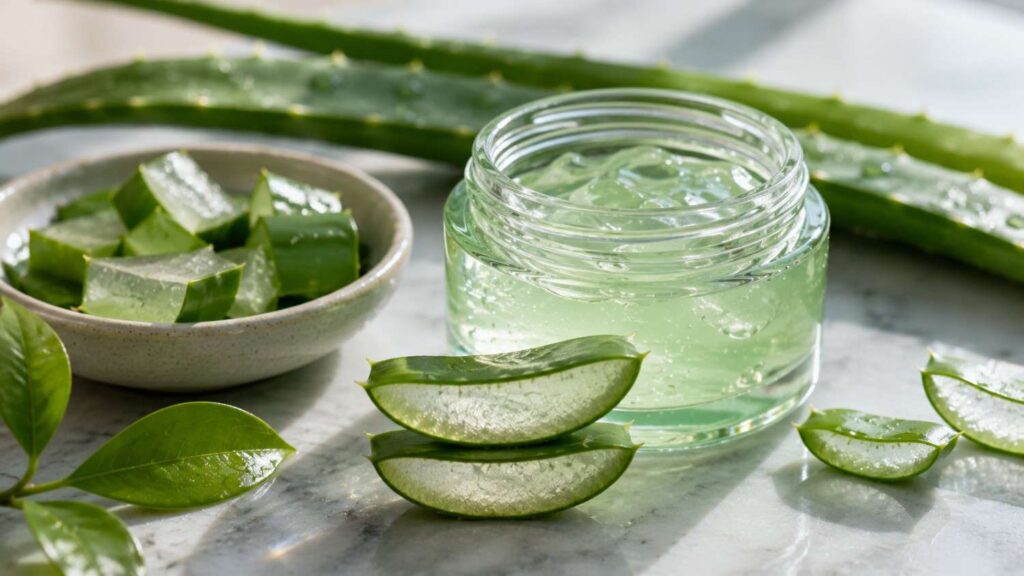
Aloe vera is a succulent plant known for its thick green leaves and clear inner gel. In skin care, this gel is valued because it spreads easily, absorbs quickly, and creates an immediate cooling sensation on the skin. The plant most commonly used in cosmetic and topical products is Aloe barbadensis Miller. Its gel is found in many products labeled as aloe vera gel, aloe leaf juice, aloe extract, soothing gel, after-sun gel, hydrating lotion, or calming moisturizer.
Aloe vera is used in skin care because it offers a combination of sensory and functional benefits. It feels fresh when applied, which makes it especially appealing when the skin feels warm or uncomfortable. It also has a high water content, so it can support lightweight hydration when used in the right formula. DermNet describes aloe vera as soothing, moisturizing, and cooling, and notes that it is commonly used for minor burns, sunburn, minor irritation, acne, abrasions, eczema, and psoriasis, although evidence strength varies depending on the skin concern.
Another reason aloe remains popular is that it can work well in simple routines. People with oily or acne-prone skin often dislike heavy creams, so a lightweight aloe-based product may feel more comfortable. People with dry or sensitive skin may appreciate aloe’s calming feel, though they usually need a moisturizer over it to reduce water loss. The key is to treat aloe as one helpful ingredient within a complete skin care formula, not as a stand-alone solution for every skin problem.
Aloe Vera Gel vs. Aloe Latex
Aloe vera gel and aloe latex come from the same plant, but they are very different substances. Aloe gel is the clear, jelly-like material inside the inner part of the leaf. This is the ingredient most commonly used in topical skin care products, including gels, moisturizers, lotions, masks, and after-sun formulas. When people talk about using aloe for the face or body, they usually mean topical aloe gel or products formulated with aloe leaf juice or aloe extract.
Aloe latex, on the other hand, is a yellowish substance found under the leaf skin. It has historically been associated with laxative use and is not the same as topical aloe gel. This difference matters because oral aloe latex can carry safety risks. Mayo Clinic warns against taking aloe latex by mouth and notes that it may be unsafe, especially in high doses.
For skin care purposes, it is best to focus on topical aloe gel products from reputable brands. Avoid confusing fresh aloe preparation with oral supplements or latex-containing products. If a product is meant for topical skin use, follow the label instructions and avoid applying it to deep wounds, infected areas, or severe burns without medical advice.
Key Compounds in Aloe Vera
Aloe vera gel is mostly water, but it also contains plant-based compounds that contribute to its use in skin care formulas. One important group of compounds is polysaccharides. These are carbohydrate-based molecules often discussed in relation to aloe’s gel texture, moisturizing properties, and soothing reputation. Acemannan is one of the best-known aloe polysaccharides and is frequently mentioned in scientific discussions about aloe leaf gel composition.
In cosmetic skin care, these compounds are relevant because they may help explain why aloe feels hydrating and comfortable on the skin. A PubMed-indexed study on cosmetic formulations found that freeze-dried aloe vera extract improved skin hydration, possibly through a humectant mechanism. A humectant is an ingredient that helps attract or hold water in the upper layers of the skin.
That said, aloe’s effect depends heavily on the final product formula. A pure aloe gel may feel cooling but may not provide enough long-lasting moisture for very dry skin. A well-formulated aloe moisturizer that also includes glycerin, ceramides, dimethicone, or other barrier-supporting ingredients may offer more complete hydration. This is why ingredient pairing matters as much as aloe itself.
Key Aloe Vera Skin Benefits for Daily Care
Aloe vera is most useful when the goal is to support comfort, hydration, and mild soothing. It is not a miracle ingredient, but it can be a practical addition to a skin care routine when used correctly. Many people use aloe when their skin feels dry after cleansing, warm after sun exposure, tight after shaving, or mildly uncomfortable after environmental stress. These are the situations where aloe’s light texture and cooling feel can be helpful.
The most important aloe vera skin benefits are connected to hydration and skin comfort. Aloe can add a water-rich layer to the skin, especially when applied to slightly damp skin. It may also make irritated skin feel calmer because of its cooling sensation. In after-sun care, aloe-containing moisturizers are often recommended for comfort, although aloe does not undo sun damage. The American Academy of Dermatology recommends moisturizers with aloe vera or soy to soothe sunburned skin after cooling the skin with baths or showers.
For daily use, aloe works best when it is part of a balanced routine. Beginners often make the mistake of using aloe alone and skipping moisturizer. This may work temporarily for oily skin, but dry or dehydrated skin usually needs more support. Advanced skin care users should also remember that aloe is not a substitute for proven active ingredients. It can sit alongside sunscreen, ceramides, niacinamide, benzoyl peroxide, retinoids, or prescription treatments, but it should not replace them when those treatments are needed.
Hydration Support for Dry Skin
One of the most practical aloe vera skin benefits is light hydration. Aloe gel contains a high amount of water and can leave the skin feeling refreshed shortly after application. Research on cosmetic formulations containing aloe vera extract suggests that aloe may improve skin hydration, possibly through a humectant-like effect. This means it may help the outer layer of the skin hold water more effectively when used in the right type of formula.
For dry skin, aloe is usually best used as a hydration layer rather than the final moisturizing step. A simple method is to apply a thin layer of aloe gel to slightly damp skin, allow it to absorb, and then follow with a moisturizer. The moisturizer helps seal in hydration and supports the skin barrier. Without that second step, water from a lightweight gel may evaporate, leaving dry skin feeling tight again.
People with very dry, flaky, or compromised skin should choose aloe products that also include ingredients such as glycerin, ceramides, panthenol, squalane, or dimethicone. These ingredients provide broader moisturizing support than aloe alone.
Soothing Support for Warm or Irritated Skin
Aloe vera is widely used because it gives the skin a cooling sensation. This is one reason aloe gel is often associated with after-sun care, post-shave comfort, and mild irritation support. When the skin feels warm, tight, or uncomfortable, a lightweight aloe product can feel refreshing and may help reduce the feeling of dryness or heat on the skin.
For sunburn discomfort, aloe should be used carefully and realistically. The American Academy of Dermatology recommends applying a moisturizer that contains aloe vera or soy while the skin is still damp after a cool bath or shower. This can help soothe the skin and improve comfort during recovery. However, aloe does not repair DNA damage caused by UV exposure, and it should never be used as a replacement for sunscreen.
If the skin is blistered, severely painful, swollen, or accompanied by fever or chills, aloe is not enough. In those cases, medical guidance is more appropriate. Aloe can support mild comfort, but serious burns need proper care and monitoring.
Helpful Addition for Minor Skin Discomfort
Aloe vera may be useful for minor skin discomfort, especially when the issue is mild dryness, tightness, post-shave sensitivity, or temporary irritation. DermNet notes that aloe vera is used because it is soothing, moisturizing, and cooling, with common uses including minor burns, sunburn, minor irritation, abrasions, acne, eczema, and psoriasis. These uses do not mean aloe is a guaranteed treatment for every condition, but they explain why it appears in many calming skin care products.
For everyday discomfort, aloe can be applied in a thin layer after cleansing or after shaving. It may help the skin feel less tight and more comfortable before moisturizer. People who shave their face, underarms, or legs may find aloe helpful when the skin feels warm afterward, as long as there are no deep cuts or open wounds.
The important rule is to watch how your own skin responds. If aloe stings, burns, creates bumps, or makes redness worse, stop using it. Mild discomfort should improve with supportive care. If it worsens, spreads, or becomes painful, professional advice is safer than repeated home treatment.
How to Use Aloe Vera in a Skin Care Routine
Aloe vera works best when used as a simple support step in a balanced skin care routine. It should not make your routine complicated. In most cases, aloe fits between cleansing and moisturizing. It can be used in the morning, at night, or after specific triggers such as sun exposure, shaving, or dryness after washing. The best timing depends on the product texture, your skin type, and whether the formula layers well with sunscreen or makeup.
The main goal is to use aloe in a way that improves comfort without overwhelming the skin. A thin layer is usually enough. Applying too much aloe gel can leave a sticky film, cause product pilling, or make the skin feel tight once the water evaporates. This is especially common when aloe is used alone on dry skin. To avoid this, apply aloe to slightly damp skin and follow with a moisturizer if your skin needs more support.
Product selection also matters. A fragrance-free aloe gel or aloe moisturizer is usually better for sensitive skin than a brightly colored, heavily scented gel. Some aloe products contain alcohol, dyes, menthol, fragrance, or essential oils, which can increase the risk of stinging or irritation. The National Center for Complementary and Integrative Health notes that topical aloe gel is generally well tolerated, but reactions such as burning, itching, rash, and eczema have been reported. For this reason, aloe should be introduced gradually, especially if you have sensitive, acne-prone, or allergy-prone skin.
Step-by-Step Aloe Vera Gel for Face Routine
A simple aloe vera gel for face routine should start with gentle cleansing. Wash your face with a mild cleanser that does not leave the skin feeling stripped or squeaky. After cleansing, leave the skin slightly damp instead of completely dry. This helps the aloe layer spread more evenly and may support better hydration.
Next, apply a thin layer of aloe vera gel or aloe-based serum. You do not need a thick coat. A pea-sized to small coin-sized amount is often enough for the face, depending on the product texture. Let it absorb for one to two minutes. If your skin is oily, this may feel like enough at night. If your skin is dry, sensitive, or tight, follow with a moisturizer to lock in hydration.
In the morning, always finish with sunscreen. Aloe can soothe skin after sun exposure, but it does not protect against UV rays. This distinction is essential. Aloe belongs in the comfort and hydration category, while sunscreen belongs in the prevention category. For best results, use aloe consistently but modestly, and avoid layering it with too many new active ingredients at once.
When to Use Aloe Vera: Morning or Night?
Aloe vera can be used in the morning or at night, depending on your routine. Morning use works well when the product is lightweight, absorbs cleanly, and layers smoothly under sunscreen. If your aloe gel pills, flakes, or feels sticky under sunscreen or makeup, it may be better to use it at night instead. Product texture often determines the best timing more than the ingredient itself.
Nighttime use is especially helpful when the skin feels tight after cleansing or warm after a long day. Aloe can be applied before moisturizer as a calming hydration layer. This approach is simple and works well for people who want a minimal routine without adding strong active ingredients.
For after-sun use, aloe should be applied after cooling the skin with a cool bath, shower, or compress. The American Academy of Dermatology recommends applying aloe-containing moisturizer while the skin is still damp for sunburn comfort. However, if the skin is blistered, severely painful, or worsening, seek medical advice rather than relying on aloe alone.
Aloe Vera Use by Skin Concern
Aloe vera can be used differently depending on the skin concern. For dry skin, it usually works best as a hydrating layer under moisturizer. For oily skin, it may feel comfortable because of its lightweight texture. For sensitive skin, it should be patch tested before full use. For sunburn discomfort, it may help soothe the skin when used in a moisturizer, but it should not be treated as a cure.
| Skin Concern | How Aloe May Help | Best Use Tip | Caution |
|---|---|---|---|
| Dry skin | Adds light hydration | Layer under moisturizer | Not enough for very dry skin alone |
| Sunburn discomfort | Helps soothe when used in moisturizer | Apply after a cool shower | Seek care for severe blistering |
| Sensitive skin | May calm mild irritation | Patch test first | Can still cause rash or burning |
| Acne-prone skin | Lightweight texture may suit oily skin | Choose non-comedogenic formula | Avoid sticky, fragranced gels |
| Post-shave skin | Provides a cooling feel | Apply thinly after shaving | Do not apply to deep cuts |
This table should be used as general guidance, not a medical treatment plan. Aloe can support comfort, but persistent rashes, acne, burns, or irritation should be assessed properly.
Aloe Vera for Different Skin Types
Aloe vera for skin care is not one-size-fits-all. The same aloe product that feels refreshing on oily skin may feel too light for dry skin or irritating for sensitive skin if it contains fragrance or alcohol. This is why it is important to think beyond the ingredient name. The full formula, your skin type, your current routine, and your skin barrier condition all influence whether aloe will be helpful.
For dry skin, aloe can provide a water-based hydration boost, but it usually needs to be paired with richer moisturizing ingredients. For sensitive skin, aloe may feel calming, but it can still cause irritation in some people. For acne-prone skin, aloe’s lightweight texture may be useful, but the product should be non-comedogenic and free from unnecessary heavy or irritating additives. The American Academy of Dermatology notes that people with acne can still need moisturizer, especially when their skin feels dry, and applying moisturizer after washing can help trap water in the skin.
Skin condition also matters. A person with healthy oily skin may tolerate aloe gel daily. A person with rosacea, eczema, or a damaged skin barrier may need to introduce aloe slowly and choose a very simple formula. Natural ingredients can be helpful, but “natural” does not automatically mean safe for every skin type. A professional approach is to match the aloe product to the skin’s needs instead of assuming aloe will work the same way for everyone.
| Skin Type | Recommended Aloe Vera Product | Key Features to Look For | Ingredients to Avoid |
|---|---|---|---|
| Dry Skin | Aloe moisturizer | Ceramides, glycerin, squalane, hyaluronic acid | High alcohol content |
| Oily Skin | Lightweight aloe gel | Oil-free, non-comedogenic formula | Heavy oils if prone to breakouts |
| Combination Skin | Aloe gel-cream | Balanced hydration with lightweight texture | Strong fragrance |
| Sensitive Skin | Fragrance-free aloe gel or moisturizer | Minimal ingredients, soothing formula, patch-test friendly | Essential oils, menthol, artificial fragrance |
| Acne-Prone Skin | Non-comedogenic aloe gel | Lightweight, fast-absorbing, oil-free | Thick occlusive formulas if they trigger breakouts |
| Normal Skin | Aloe gel or moisturizer | Hydrating, fragrance-free formula | Products with unnecessary dyes or irritants |
Aloe Vera for Dry Skin
For dry skin, aloe vera can help add light hydration, but it should not be the only moisturizing step. Dry skin usually needs three types of support: humectants to attract water, emollients to soften the skin, and occlusives to reduce water loss. Aloe may contribute to the humectant side of hydration, but it does not always provide enough barrier support by itself.
A better approach is to use aloe gel or an aloe serum under a moisturizer. Apply aloe to damp skin, allow it to absorb, and then apply a cream or lotion that contains ingredients such as glycerin, ceramides, dimethicone, petrolatum, squalane, or panthenol. This combination can help the skin feel hydrated for longer.
People with dry skin should be careful with pure aloe gels that contain alcohol or strong fragrance. These may feel cooling at first but can leave the skin feeling tighter later. If your skin becomes flaky, rough, or uncomfortable after aloe, the product may not be moisturizing enough. In that case, switch to an aloe moisturizer instead of relying on a simple gel.
Aloe Vera for Sensitive Skin
Aloe vera is often marketed as gentle, but sensitive skin still needs caution. Sensitive skin can react to many ingredients, including botanical extracts, preservatives, fragrance, dyes, and alcohol. Even aloe itself may cause problems for some people. The National Center for Complementary and Integrative Health notes that topical aloe gel is generally well tolerated, but occasional burning, itching, rash, and eczema have been reported.
For sensitive skin care, choose a fragrance-free aloe product with a short and simple ingredient list. Avoid formulas that contain perfume, menthol, strong essential oils, or unnecessary colorants. These additions may make the product feel more refreshing or appealing, but they can increase the risk of irritation.
Patch testing is especially important for sensitive skin. The American Academy of Dermatology recommends testing new skin care products on a small area twice daily for seven to 10 days before wider use. This helps reduce the risk of applying an irritating product across the entire face. If aloe causes redness, itching, swelling, or burning, stop using it.
Aloe Vera for Acne-Prone Skin
Aloe vera gel for face routines can be useful for acne-prone skin because many aloe products feel lightweight and non-greasy. People with acne often avoid moisturizers because they worry about clogged pores, but this can lead to dryness and irritation, especially when using acne treatments. The American Academy of Dermatology explains that people with acne may need moisturizer when their skin feels dry and that applying it after washing can help trap water in the skin.
Aloe may be a good support ingredient in this context, but it is not a primary acne treatment. It should not replace proven options such as benzoyl peroxide, salicylic acid, adapalene, retinoids, or dermatologist-prescribed medications. Instead, aloe can help maintain comfort while acne treatments do the main work.
For acne-prone skin, choose an aloe product labeled non-comedogenic or oil-free when possible. Avoid sticky gels, heavy oils, thick occlusive formulas, or fragranced products that may worsen irritation. If breakouts increase after using aloe, stop and reassess the product. The issue may be the formula rather than aloe itself.
Safety, Side Effects, and Patch Testing
The Benefits of Aloe Vera for Skin Care are strongest when aloe is used safely and with realistic expectations. Most people tolerate topical aloe well, but skin reactions can happen. This is especially important for people with eczema, rosacea, allergy-prone skin, compromised skin barrier, or a history of contact dermatitis. A product can be popular, natural, and widely used while still causing irritation for certain users.
Safety begins with choosing the right product. A simple aloe gel or aloe moisturizer is usually a better choice than a product with fragrance, dyes, menthol, or strong essential oils. It is also important to avoid applying aloe to serious skin problems without guidance. Deep wounds, infected skin, severe burns, painful rashes, and worsening irritation need proper medical evaluation. Mayo Clinic notes that aloe gel is generally safe when used as suggested and may help with some skin conditions, but it also warns against oral aloe latex.
Patch testing is one of the easiest ways to reduce risk. Many skin reactions do not appear immediately. Some develop after repeated exposure over several days. The American Academy of Dermatology recommends testing a product twice daily for seven to 10 days on a small area before applying it more widely. This is particularly useful before applying aloe to the face, where reactions can be more noticeable and uncomfortable.
Possible Side Effects of Aloe Vera on Skin
Possible side effects of topical aloe vera include burning, itching, redness, rash, hives, swelling, or eczema-like irritation. These reactions are not common for everyone, but they are possible. The National Center for Complementary and Integrative Health states that topical aloe gel is generally well tolerated, while also noting occasional reports of burning, itching, rash, and eczema.
A reaction may be caused by aloe itself or by other ingredients in the product. Many commercial aloe gels contain preservatives, fragrance, alcohol, dyes, or cooling agents. These ingredients can make the product feel pleasant at first but may irritate sensitive skin. This is why reading the full ingredient list matters.
If your skin reacts after using aloe, stop applying the product. Wash the area gently with lukewarm water and avoid layering more active ingredients over irritated skin. If the reaction is mild, a bland moisturizer may help support recovery. If the reaction is severe, painful, spreading, or persistent, a dermatologist or qualified clinician should evaluate it.
How to Patch Test Aloe Vera
Patch testing is a simple safety step before adding aloe vera to your skin care routine. The American Academy of Dermatology recommends applying a new product to a small test area twice daily for seven to 10 days. A good test spot is the underside of the arm or the bend of the elbow, where the product is less likely to be rubbed or washed away.
Use the same amount and thickness that you would normally apply to your face or body. Leave the product on for the same amount of time you would during regular use. If you are testing a leave-on aloe gel or moisturizer, leave it on. If you are testing a rinse-off aloe mask or cleanser, rinse it according to the instructions.
Watch for redness, itching, swelling, bumps, burning, or rash. If none of these appear after seven to 10 days, the product is less likely to irritate your skin. A patch test cannot guarantee that you will never react, but it reduces the risk of a widespread reaction. For sensitive skin, this step is worth the extra time.
When Not to Use Aloe Vera
Aloe vera should not be used as a do-it-yourself solution for every skin issue. Do not apply aloe to deep wounds, infected skin, severe burns, large blisters, rapidly spreading rashes, or skin that is extremely painful without medical advice. If the area is oozing, hot, swollen, or worsening, aloe is not enough. These signs may suggest infection or a more serious skin problem that needs professional care.
Aloe should also be avoided if it causes stinging, burning, itching, or redness after application. Some people continue using aloe because they assume a natural product must be safe, but discomfort is a warning sign. Stop using the product and allow the skin to recover.
Be especially careful with fresh aloe directly from the plant. While fresh aloe can feel soothing, it is not standardized like a properly formulated product. It may contain impurities from handling, leaf residue, or latex contamination if prepared incorrectly. For facial use, a reputable fragrance-free aloe product is often a safer and more consistent option.
How to Choose a Good Aloe Vera Skin Care Product
Choosing the right aloe vera skin care product is just as important as deciding to use aloe in the first place. The front label may say “soothing,” “natural,” or “pure aloe,” but the ingredient list tells the real story. A good product should match your skin type, avoid unnecessary irritants, and fit into your routine without causing stickiness, dryness, or breakouts.
Start by checking where aloe appears on the ingredient list. Aloe may be listed as Aloe barbadensis leaf juice, Aloe barbadensis leaf extract, aloe vera gel, or aloe leaf juice. If aloe appears near the top, the product likely contains a meaningful amount. If it appears near the bottom, it may be present in a smaller amount, although the final formula can still be useful depending on the other ingredients.
For dry skin, an aloe moisturizer may be more effective than a plain aloe gel. For oily or acne-prone skin, a lightweight gel or gel-cream may feel better. For sensitive skin, fragrance-free and dye-free formulas are usually safer. NCCIH notes that topical aloe gel is generally well tolerated but can occasionally cause burning, itching, rash, or eczema, so choosing a simple product and patch testing remain important.
The best aloe product is not always the one with the highest aloe percentage. It is the one that supports your skin without irritation and works well with the rest of your routine.
What to Look for on the Label
When choosing an aloe vera product, look for ingredient names such as Aloe barbadensis leaf juice, Aloe barbadensis leaf extract, aloe vera gel, or aloe leaf juice. These names indicate that the product contains aloe-derived material. If you want aloe to be a key ingredient, check whether it appears near the beginning of the ingredient list.
For sensitive skin, look for “fragrance-free” rather than only “unscented.” Unscented products may still contain masking fragrance ingredients. Fragrance-free formulas are generally a better choice for people who react easily. Also consider products labeled hypoallergenic, though this claim does not guarantee that irritation will never happen.
For acne-prone skin, look for non-comedogenic or oil-free wording. These labels can help guide selection, but they should not replace personal observation. Your skin’s response is the final test. If a product causes clogged pores, bumps, or increased breakouts, discontinue it.
For dry skin, look for aloe combined with glycerin, ceramides, panthenol, squalane, hyaluronic acid, or dimethicone. These ingredients can make the product more complete than aloe alone. A well-balanced formula usually performs better than a basic gel.
Ingredients That Pair Well With Aloe Vera
Aloe vera pairs well with many skin-supporting ingredients. Glycerin and hyaluronic acid can strengthen the hydrating effect because they also work as humectants. Panthenol can support comfort and softness. Ceramides help reinforce the skin barrier, which is especially useful for dry or sensitive skin. Dimethicone can help reduce water loss and create a smoother feel without necessarily being heavy.
Niacinamide is another useful partner in many aloe moisturizers. It can support barrier function, uneven tone, and overall skin resilience when used in an appropriate concentration. Squalane may be helpful for people who need extra softness but dislike greasy textures. Together, these ingredients can turn aloe from a simple cooling gel into a more complete moisturizer.
The best formula depends on skin type. Oily skin may prefer aloe with glycerin and niacinamide in a gel-cream. Dry skin may prefer aloe with ceramides and dimethicone in a richer lotion. Sensitive skin may prefer aloe with panthenol and minimal additives. The goal is not to use the most ingredients, but to choose a formula where every ingredient has a purpose.
Ingredients to Be Careful With
Some aloe vera products contain ingredients that can irritate the skin, especially when the skin barrier is already stressed. Be careful with products that contain high levels of alcohol, added fragrance, artificial dyes, menthol, eucalyptus oil, peppermint oil, or strong essential oils. These ingredients may create a cooling or fresh sensation, but that sensation is not always a sign of skin repair.
Alcohol-heavy gels can be especially problematic for dry or sensitive skin. They may evaporate quickly and make the skin feel temporarily cool, but they can also increase dryness or tightness. Fragrance can also be an issue because it is a common trigger for irritation and allergic contact dermatitis in sensitive users.
If your goal is sensitive skin care, choose a simple fragrance-free aloe product. If your goal is acne-prone skin care, avoid heavy oils and sticky formulas that may feel uncomfortable or contribute to congestion. If your goal is after-sun comfort, avoid products with benzocaine, lidocaine, or harsh cooling agents unless a clinician recommends them. A calming product should leave skin feeling better, not more inflamed.
| Ingredient | Main Benefit | Why It Works Well With Aloe Vera | Best For |
|---|---|---|---|
| Glycerin | Draws moisture into the skin | Enhances aloe’s hydrating effect by attracting water to the skin surface | Dry and dehydrated skin |
| Hyaluronic Acid | Boosts hydration | Works alongside aloe to improve skin moisture without feeling heavy | All skin types |
| Ceramides | Strengthens the skin barrier | Helps lock in the hydration provided by aloe vera | Dry and sensitive skin |
| Niacinamide | Supports barrier function and reduces redness | Complements aloe’s soothing properties for irritated skin | Sensitive and combination skin |
| Panthenol (Provitamin B5) | Calms and moisturizes | Increases skin comfort while supporting hydration | Irritated or compromised skin |
| Dimethicone | Reduces moisture loss | Forms a protective layer that helps keep aloe’s hydration in the skin | Very dry skin |
| Squalane | Softens and smooths skin | Adds lightweight moisture without making skin greasy | Dry and acne-prone skin |
Quick Answer About The Benefits of Aloe Vera for Skin Care
Aloe vera can be a valuable skin care ingredient because it supports hydration, provides a cooling feel, and may help soothe skin that feels dry, warm, tight, or mildly irritated. The clear gel found inside aloe leaves is water-rich and commonly used in moisturizers, facial gels, after-sun products, masks, and calming skin care formulas. Many people use aloe because it feels lightweight and refreshing, especially compared with heavier creams or oils.
The Benefits of Aloe Vera for Skin Care are best understood as supportive benefits, not medical cures. Aloe may help improve skin comfort, but it should not replace sunscreen, prescription treatments, burn care, acne medication, or dermatologist-guided therapy for ongoing skin conditions. For sunburn discomfort, the American Academy of Dermatology recommends applying a moisturizer that contains aloe vera or soy while the skin is still damp after a cool bath or shower. This can help soothe the skin, but it does not reverse UV damage or remove the need for sun protection.
Research also suggests that cosmetic formulations containing freeze-dried aloe vera extract may improve skin hydration, possibly because aloe can act in a humectant-like way by helping the upper layers of skin hold water. Still, aloe does not work for everyone. The National Center for Complementary and Integrative Health notes that topical aloe gel is generally well tolerated, but burning, itching, rash, and eczema-like reactions have occasionally been reported. For that reason, patch testing is important before applying aloe widely, especially on the face or sensitive skin.
Frequently Asked Questions
This FAQ section answers common questions about The Benefits of Aloe Vera for Skin Care in a direct and beginner-friendly way. Many people hear that aloe is good for the face, dry skin, sunburn, acne, and sensitive skin, but they are not always sure how to use it safely. The truth is that aloe can be helpful, but its results depend on skin type, product quality, and the concern being addressed.
Aloe is best viewed as a supportive ingredient. It can hydrate, cool, and soothe mild discomfort, but it cannot replace sunscreen, prescription treatment, wound care, or professional dermatology advice. It also cannot guarantee results for acne, eczema, psoriasis, or severe irritation. This balanced understanding helps prevent disappointment and reduces the risk of overusing aloe in situations where another treatment is needed.
The questions below also address important safety points. Although aloe is often marketed as gentle and natural, reactions can still occur. NCCIH reports that topical aloe gel is generally well tolerated but has occasionally been associated with burning, itching, rash, and eczema. That is why patch testing, simple formulas, and gradual use are recommended. Whether you are using aloe vera gel for face care, aloe moisturizer for dry skin, or aloe for sunburn discomfort, start slowly and observe how your skin responds.
Is aloe vera good for your face?
Yes, aloe vera can be good for the face when it is used in a suitable formula and your skin tolerates it well. Aloe may help the face feel hydrated, cool, and more comfortable, especially when the skin feels tight after cleansing or mildly irritated after environmental exposure. Its lightweight texture can also make it appealing for people who dislike heavy creams.
However, aloe is not automatically right for every face. Sensitive skin can still react to aloe or to other ingredients in an aloe product, such as fragrance, alcohol, preservatives, or dyes. If you are using aloe vera gel for face care, choose a fragrance-free product and apply a thin layer. Follow with moisturizer if your skin feels dry.
Aloe should not replace sunscreen in the morning or prescription treatment for acne, eczema, rosacea, or dermatitis. It is best used as a supportive hydration and comfort step. Patch test first, especially if your skin reacts easily.
Can aloe vera help dry skin?
Aloe vera can help dry skin by adding light, water-based hydration. Research on cosmetic formulations containing aloe vera extract found improved skin hydration, possibly through a humectant mechanism. This means aloe may help support moisture in the upper layers of the skin when used correctly.
However, dry skin usually needs more than a gel. Aloe alone may feel refreshing at first but may not prevent water loss for long. This is why it is often better to layer aloe under a moisturizer. Apply aloe to slightly damp skin, wait a minute, and then apply a cream or lotion with barrier-supporting ingredients.
Look for products that combine aloe with glycerin, ceramides, panthenol, squalane, dimethicone, or hyaluronic acid. These combinations are more useful for dry skin than a basic aloe gel alone. If your skin feels tight after using aloe, your routine needs a stronger moisturizer.
Does aloe vera help sunburn?
Aloe vera can help soothe sunburn discomfort, especially when used in a moisturizer. The American Academy of Dermatology recommends applying a moisturizer that contains aloe vera or soy while sunburned skin is still damp after a cool bath or shower. This can help the skin feel more comfortable during recovery.
However, aloe does not undo UV damage. A sunburn is a sign that the skin has been injured by ultraviolet radiation. Aloe may reduce discomfort, but it does not erase the harm caused by sun exposure. Prevention remains the most important step, including sunscreen, protective clothing, shade, and avoiding intense midday sun.
For mild sunburn, cool baths, gentle moisturizing, hydration, and aloe-containing moisturizer may help. For severe blistering, fever, chills, dizziness, or widespread burns, seek medical advice. Aloe is a comfort measure, not a substitute for medical care when a burn is serious.
Can aloe vera irritate sensitive skin?
Yes, aloe vera can irritate sensitive skin in some cases. Although many people tolerate aloe well, reactions are possible. NCCIH notes occasional reports of burning, itching, rash, and eczema after topical aloe gel use. These reactions may come from aloe itself or from added ingredients in the product.
Sensitive skin users should be especially careful with formulas that include fragrance, menthol, essential oils, dyes, or high levels of alcohol. These ingredients can increase the chance of stinging or redness. A simple fragrance-free aloe product is usually a better choice.
Patch testing is strongly recommended. Apply the product to a small area twice daily for seven to 10 days, as recommended by the American Academy of Dermatology. If you notice redness, itching, burning, swelling, or bumps, stop using the product. Sensitive skin benefits from caution, not trial-and-error over large areas.
How often should I use aloe vera on my skin?
Most people can start using aloe vera once daily or a few times per week, depending on the product and their skin tolerance. If your skin responds well, you may use it more consistently as a hydration or soothing step. If your skin feels sticky, tight, dry, or irritated after application, reduce frequency or switch products.
For the face, a thin layer is enough. More product does not always mean better results. Too much aloe gel can pill under sunscreen, feel tacky, or dry down uncomfortably. For dry skin, aloe should usually be followed with moisturizer. For oily skin, aloe may be used alone if it feels comfortable, but hydration should still be monitored.
If you are using other active ingredients such as retinoids, exfoliating acids, or acne treatments, introduce aloe slowly. Adding too many products at once makes it harder to know what is helping or irritating your skin. Stop using aloe if burning, itching, rash, or swelling appears.
Is fresh aloe vera better than store-bought aloe gel?
Fresh aloe vera is not automatically better than store-bought aloe gel. Fresh aloe can feel cooling, but it is not standardized. The quality, purity, and concentration can vary depending on the plant, how it is cut, how it is stored, and whether any yellow latex residue remains near the leaf lining. This matters because aloe latex is different from aloe gel and is not the part typically used for topical skin care.
Store-bought aloe products may offer more consistency because they are formulated, preserved, and labeled for cosmetic use. A well-made fragrance-free aloe gel or aloe moisturizer from a reputable brand is often easier to use safely, especially on the face. It may also include supporting ingredients that improve hydration and skin feel.
Fresh aloe may be suitable for some people, but it should still be patch tested. Avoid applying fresh aloe to deep wounds, severe burns, infected skin, or active rashes. For sensitive or acne-prone facial skin, a properly formulated product is usually the more practical choice.
Conclusion
Aloe vera is a useful skin care ingredient when it is used with realistic expectations. It can help support hydration, provide a cooling feel, and soothe mild discomfort, which makes it a popular choice for dry skin, after-sun care, post-shave comfort, and simple calming routines. The Benefits of Aloe Vera for Skin Care are strongest when aloe is used as part of a balanced routine that also includes gentle cleansing, moisturizing, sunscreen, and targeted treatment when needed.
The main advantage of aloe is its versatility. It can work for different skin types when the formula is chosen carefully. Dry skin may benefit from aloe layered under a richer moisturizer. Oily or acne-prone skin may appreciate a lightweight aloe gel or gel-cream. Sensitive skin may find aloe calming, but only if the product is simple, fragrance-free, and well tolerated. Because reactions are possible, patch testing remains an important step before applying aloe widely.
Aloe should not be treated as a replacement for medical care. It does not replace sunscreen, prescription acne treatment, eczema management, burn care, or professional advice for ongoing skin problems. Mayo Clinic notes that aloe gel is generally safe when used as suggested, but oral aloe latex should be avoided because of safety concerns.
In short, aloe vera can be a smart support ingredient. Use it thoughtfully, choose the right product, avoid irritating formulas, and pay attention to how your skin responds.
Final Takeaway
The Benefits of Aloe Vera for Skin Care are best understood as supportive rather than curative. Aloe can help hydrate, cool, and comfort the skin, especially when used in simple, fragrance-free formulas. It may be useful for dry skin, mild irritation, post-shave tightness, and after-sun discomfort, but it should not be expected to solve every skin concern.
For dry skin, aloe works best under a moisturizer. For oily or acne-prone skin, a lightweight non-comedogenic aloe product may be a good option. For sensitive skin, patch testing is essential because even gentle-looking products can cause reactions. For sunburn, aloe-containing moisturizer may help soothe discomfort, but prevention with sunscreen and protective clothing is still the most important step.
Aloe is most effective when it is used consistently, lightly, and safely. Choose formulas carefully, avoid unnecessary fragrance or alcohol-heavy products, and stop using aloe if your skin becomes red, itchy, swollen, or irritated.